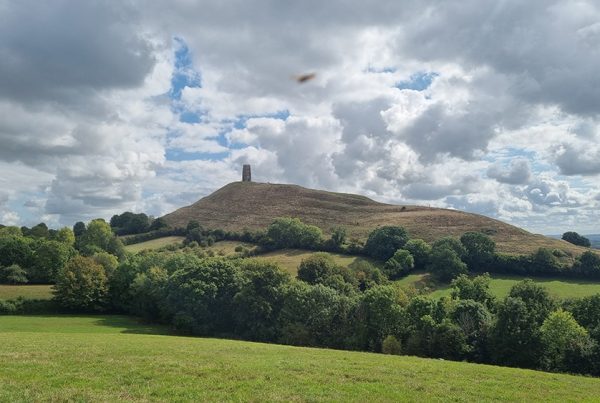
The dark of Samhain is upon us.The weeks are strewn across the lawn, days blown along on the autumn winds like leaves tossed off branches, dancing for moments before submitting to the ground to be mulched with all the other days. It is in the mess of this fertile dark under-earth that we sink into dreams and grow into the roots of tall trees.
Samhain is a significant time for me as my birthday falls on the 5th of November. I have always celebrated around this time, enjoyed fireworks and bonfires. It wasn’t until I moved to Glastonbury that I learned this period was significant for things other than dressing up as ghosts and burning recusants upon bonfires. It’s a nice coincidence that full moon and the release of this newsletter falls on this day.
The deeper resonance of this cross-quarter, being caricatured in the new modern theatrical celebrations, is of a “thinning of the veil,” a permeation in the boundaries between realms, allowing the living to gain contact more easily with the dead. Practically speaking, it is the last harvest when all that we have is brought in and those animals that can’t be wintered are slaughtered and thier meat preserved, perhaps the reason for this season’s association with death and rebirth.
At this time, a common folkloric tale is told of the Wild Hunt, led by the king of the underworld, Gwyn ap Nudd, a raucous charge on horseback with the Cŵn Annwn, a pack of white dogs with red ears, rounding up the souls and escorting them into the next realm. The character Gwyn features in Glastonbury mythology; it’s said his kingdom lies within the hollow hill of Glastonbury Tor, the connection given more weight by the meaning of the fairy king’s name, Gwyn meaning light, and Nudd, relating to mist.
 Recent adventures across this autumnal landscape have taken me out to the eastern Mendips, close to the next significant point eastward on the St Michael leyline, Stoke St Michael, where, nestled down in the valleys between the hollows and combes, run fresh springs forming the birthplace of the River Mells.
We stopped at the bottom of a holloway known as Lime Kiln Road, where we were drawn from the main way by a welcoming gate surrounded by old stone and enclosing a venerable sycamore in the midst of dropping. Its yellow-leafed road led us around the base of a terraced combe, where other venerable trees greeted us, a notable oak and one of the biggest white beams I have ever seen.
As we rounded the path, the sound of rushing water poured into perception. We approached the source of the gushing to find old trackways, a stone pillar gate and broken-down stone walls. A brick-capped spring head, surrounded by Victorian wrought-iron railings, poured into a pool scattered with the spoils of limestone quarrying and pieces of old wall, watched over by ancient hazel coppices and large beech trees. It felt like we had discovered an autumnal paradise and a perfect puzzle to be solved, this place had clearly been used for purposes other than our leisurely visit in the not too distant past.
 The pool ran off into a culvert that led on to a weir where the water fell away into a brick tunnel, disappearing underground before reappearing into a further culvert running alongside the ruins of a large building. We followed the way of the water to its disappearance, a second weir that sent the water underground again, only to reappear over the fence in woodland that had within it further ruins of old stone buildings.
Around and about were venerable beech trees of some age, one a double-trunked monster in particular with a girth of over five metres, as well as girthed hazel coppices with hollow centres, old sycamores, and a considerably sized redwood. The area is quite enchanting, and it wasn’t until I returned home and researched our expedition in retrospect that the true depth of the tale was uncovered.
With a little digging, I found that the remnants of the buildings we were walking beside were of the lost village of Stokeland Bottom. The weir, culverts, and large building were an old logwood* and paper mill that probably fell out of use in the 1850s, thus ending the life of the village.
*Logwood is a tropical hardwood processed for it’s purple – black die. Logwood milling requires similar processes to paper milling hence the mill is adopted for both uses.
“STOKE BOTTOM (Nos. 16 & 17)
Collinson (op. cit., III, p.484) notes a logwood* and paper mill in the hamlet of Stoke Bottom…”
Source—

“Sometimes the growth of a nearby town or village doomed a smaller place; this was the case with Stoke Bottom which had a paper mill as the main industry of the little village. As the paper mills in nearby Wookey Hole became larger and more successful, so other mills in the area began to fail and eventually, Stoke Bottom’s mill and the village itself was abandoned, and is now a ghost village.”
Source
Paper milling was a major Mendip industry from the late 1700s, which gives us some idea of the lifespan of this village. That isn’t to say it wasn’t inhabited previously for some time before it took up paper milling. The spring itself is the rising point of an underground river that flows through the valley as the Mells stream and then on to create the Mells River which runs into the Frome and then on to the Bristol Avon.
I delved into the old OS maps dating to the early 1820s that show Stokeland Bottom (later shortened to Stokes Bottom) with a small collection of buildings, and reveals that its nearby spring was not just any spring, but a holy one dedicated to one of the most important abbots of Glastonbury Abbey, St Dunstan. It’s apparent too that in 1253 a section of land at Stoke St Michael was given to Glastonbury abbey.
Nearby Doulting was owned by Glastonbury and one of the main sources of stone used to build the abbey. If I were allowed to fantasise without restraint: It may be within the realms of a romantic reality to say that the travelling monks of Glastonbury abbey, had visited this very well while tending to business at Stoke Lane (Stoke St Michael). That said there is an abundance of other water sources in the area!

Digging still further into this mysterious landscape, it is revealed that there is a network of caves, one associated with the well, and further caves up on the hill named the Fairy Quarry Caves where iron age pottery was discovered, proving this locality has been inhabited for millennia, and why not, given its fertile earth, abundance of stone, fresh water and protective geography, it’s hardly surprising.
It appears we found a paradise off the beaten track on the old trails of Glastonbury Abbey, a location that lead us through the ages of industry back to the medieval, then back further still to the iron age. Having dived head first into the history of the area, I can’t wait to return to the location with all this fresh context. One map shows that the spring has three rising points, West, East and North. one of which I missed. So, there are plenty of reasons to revisit the site, if an excuse should be needed at all.
Until next time, I leave you with this video of the well, weir and mill at Stokes Bottom.


UPCOMING TREE WALKS:
The last tree walks of the season are as follows:
Private walks are available to book at a date and time to suit you – Book.

Claycorns – New Batch
Claycorns – Christmas Orders
Claycorns are now available to pre order for Christmas. The usual styles are available, as well as the new colours above, these come as standard alter pieces, hung upon pendants, or on hand twisted lime twine bracelets. The collection is also available at Dandelion Dreamz and Dickett’s art supplies on Glastonbury High Street and Matt will have a little stall at the Frost Fayre at the end of November.
Contact Matt to pre-order and he will be in touch to confirm your desired Claycorns.
VISUAL DIARY
-

- Stourhead

-

- St Benedict’s Holy Thorn

-

- Tree Walk – Mum and Sister

-

- Leaf Art Glastonbury Abbey

-

- Leaf Art Glastonbury Abbey

-

- Leaf Art Glastonbury Abbey

-

- Oak Gall Mandala

-

- Oak Gall Mandala

-

- Oak Gall Mandala

-

- Tulip Tree – Street Cemetery

-

- Birch

-

- Claycorn Keeper

-

- Autumnal Junction

-

- Medlar

-

- Tulip Tree – Glastonbury Abbey

-

- Tulip Tree – Abbots Kitchen

-

- Maple

-

- Stourhead

-

- Stourhead

-

- Sycamore Skeleton

-

- Fern Leaved Beech

-

- Linden Art – 2 months on

-

- Stourhead – Cypres, Oak, Tulip tree, Birch

-

- Stourhead
-

- Return Of The Sun

-

- Matt – Leaf art

-

- Tree inspection