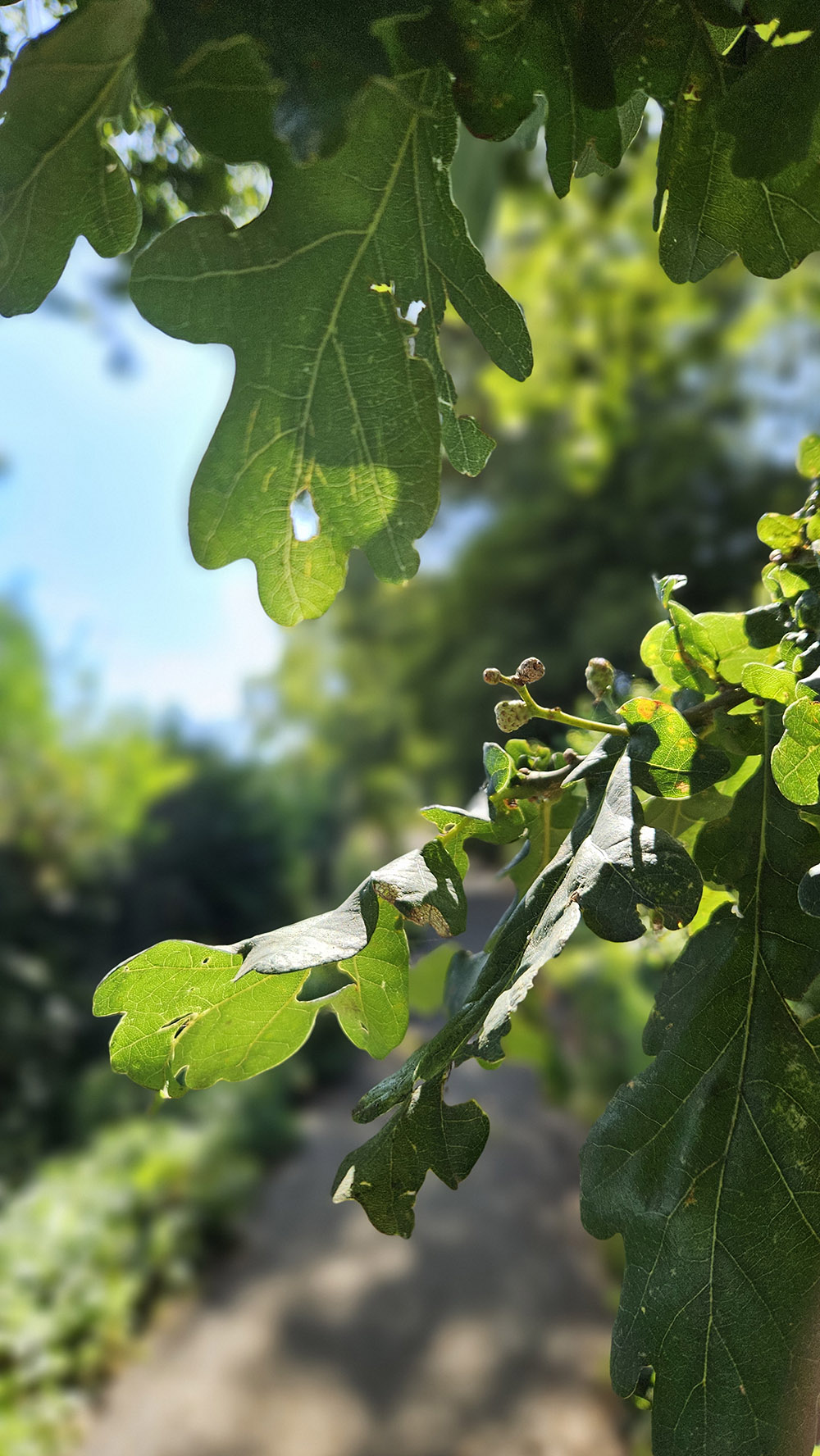
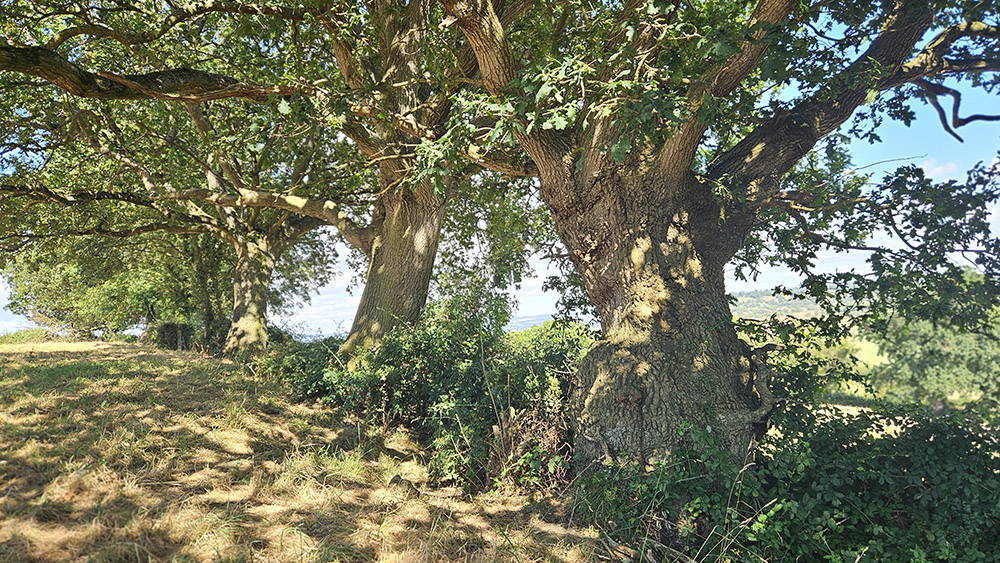
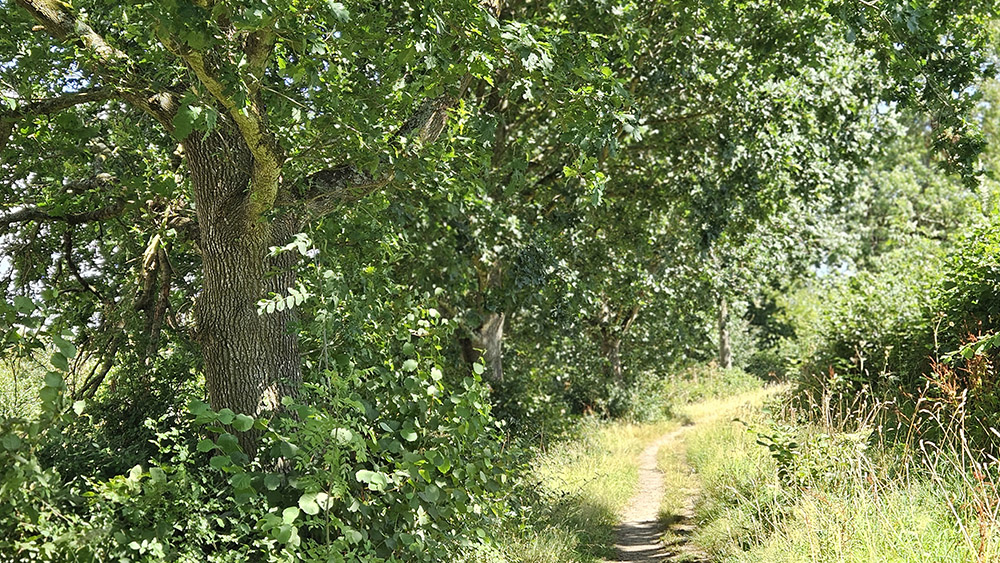
The Oaks of Avalon are spaced like constellations across Glastonbury’s golden slopes. The major oaks of these lands appear not to have sprung up from the busy endeavours of jay or squirrel, but seem to appear in a pre arranged pattern that encourages one to wonder if they were planted by humans according to some underlying code, their layout a key to some hidden journey, a map drawn through their roots that invites us into the depths of nature’s story.
If not dropped precisely like pins hooked together by thread on a detective’s cork board, then they are laid out in long lines, strung along walkways and winding beside the mounds. They guide us from one somewhere to another somewhere known only to themselves and perhaps their planters who appear to have made precise counts as to their location, numbers, and directions.
 View the interactive Google Earth map.
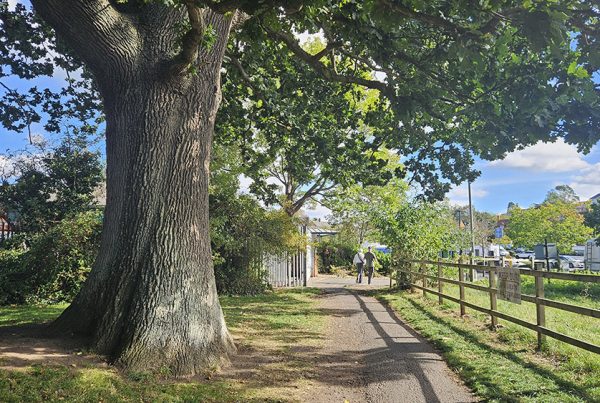
Rows of oaks hunch like lines of pilgrims across the snaking back of Stone down, starting out near Gog and Magog at Wick, they continue up the slope effectively joining the ancients to another mature notable oak on Paradise lane. So too do the oaks gather along the perilous straight on the south western entrance to this undulating cathedral, and in such numbers that they obscure the spectacular view of Glastonbury Tor in its most vocal pyramidal form.
The rows continue all the way along the base of the hill they call Wearyall, given adequate spacing to allow them to sing in their fullness. Approaching the junction, more mature oaks stand in the overgrown hedges peering out at the ‘gurt’ monolith sat upon the mounded roundabout. They also line upon the road from Wick towards the untouched pastures of Maidencroft. Here, they form a short avenue which in its maturity, onwards of 200 years from now, will be a sight to behold.

Chalice Hill Oak
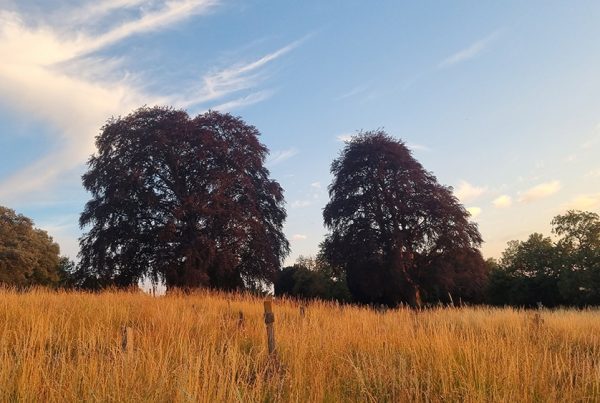
The largest oaks on the isle reach out from that conspicuous bump called Challice hill beneath which, it is claimed, still lies the grail. The hill in its current form is pregnant with mystery, heaped up with legend and is hiding something that only the penetrating tendrils of the great oaks might know.
The three of them line up on the northern arc of the hill gazing at its shallow rounded hump, and its backdrop of angular Tor. They gain girth from right to left. The largest, most ominous tree, pictured above, has a belly of 5-6 metres, making it the Avalon oak with the largest waist measurement, on a par with Gog and Magog, but in a far more youthful stage of it’s life.

Magog – Ancient Oak
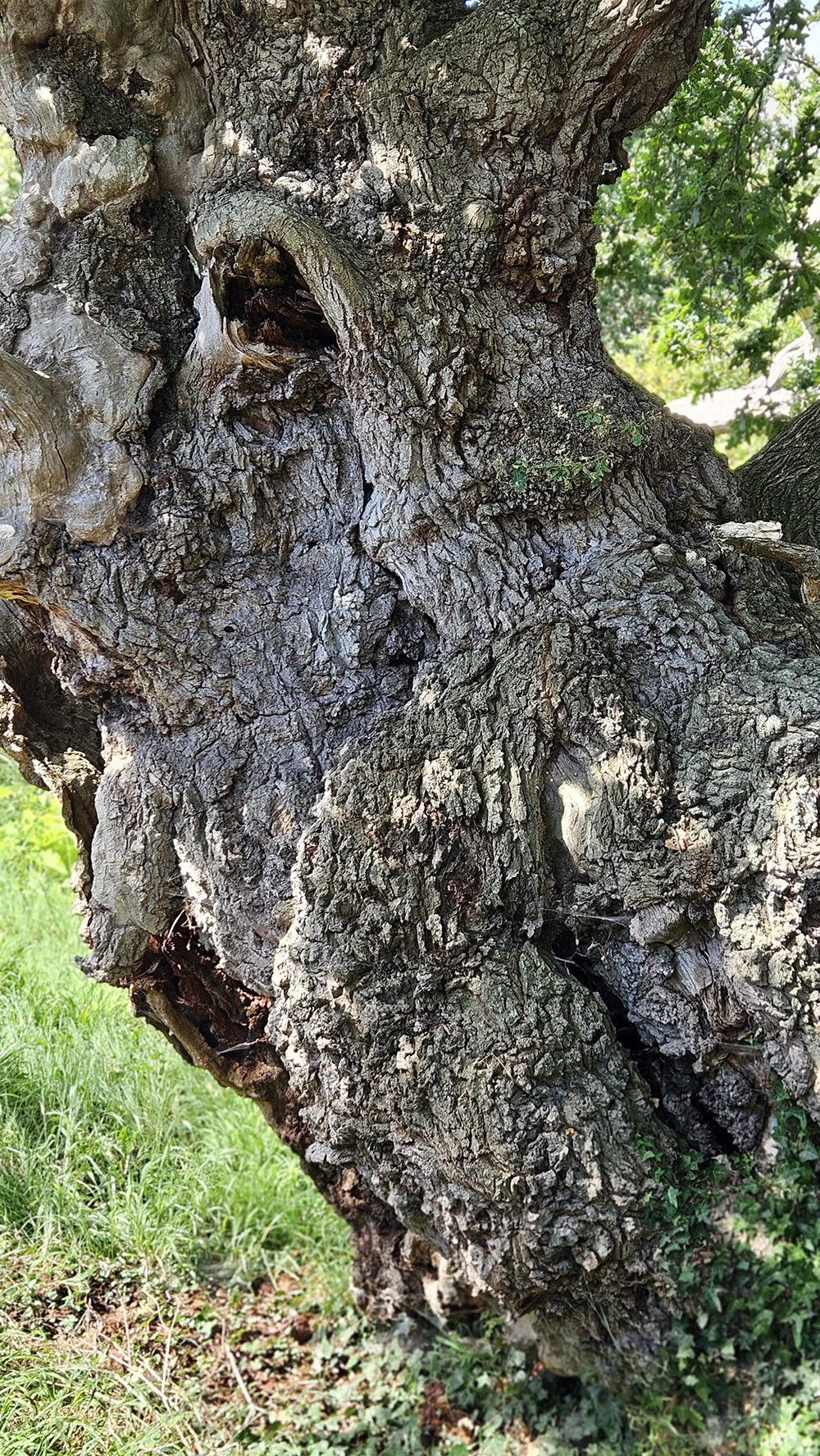
Local lore says that the two oaks, Gog and Magog, are the only remaining oaks of a druidic processionary avenue that led to the Tor. Magog now stands in her own fenced sanctuary, her base is sunken along the side of an old ditch and has become so buttressed and swollen that, if not extending into a branched green canopy, she might be mistaken for a weathered old rock. Her main structure is cracked open revealing what’s left of her heart wood and a single old branch reaches out over the fence to feel for the touch of human fingers. Her partner, Gog, dead yet still standing, remains to haunt pilgrims with his ghostly monolithic presence, looking more like an illuminated stone giant of Avebury than an oak tree.
Then there’s the “Avalon Oak” itself, known to some as the “Evidence” oak; evidence that Joseph of Arimathea landed here with his thorn staff in 63 AD. This oak sits on the bank of stone down, sitting very close to the line that is drawn east from the Abbey, travels through Bushy coombe, along Fairy lane, towards the Abbot’s palace, before leaving the isle to pass Stonehenge and then eventually arrive at Canterbury Cathedral.
This tree is not the original marker which had held the bounds at that spot ‘forever’ and, so they say, was of such importance that not long after it fell in the mid 1800s it was soon replaced by the tree we see today. The Avalon oak’s trunk has a very particular lean, perhaps pushed by grazing cattle in its younger age, if not purposefully angled to hint to visitors their path towards the inner isle. A more detailed article exploring this oak can be found here.
The Singing Oak
Over the years, I have returned to one particular oak in the landscape, sitting within its vicinity during the Summer with my music and words. The tree can be seen on the left from the section of Stone Down Lane that travels south towards the Tor’s elongated silhouette.
It is not a particularly old or girthy oak. It does not have the spiralling branches of the nearby wiggly oak, the exposed roots or buttressing of the Wick Hollow oaks, nor the age and wounds of Magog. But it dose have a perfectly round canopy and a secluded location that first drew me towards it.
I have come to know it as the Singing Oak. While I sing beneath it, the tree seems to sing back to me. I have often used it to divine parts of songs. It seems to perk up, invoke a gust of wind or release a sudden burst of wren song when it is pleased with what it hears, confirming that a chord progression or the choice of a particular word is the correct one.
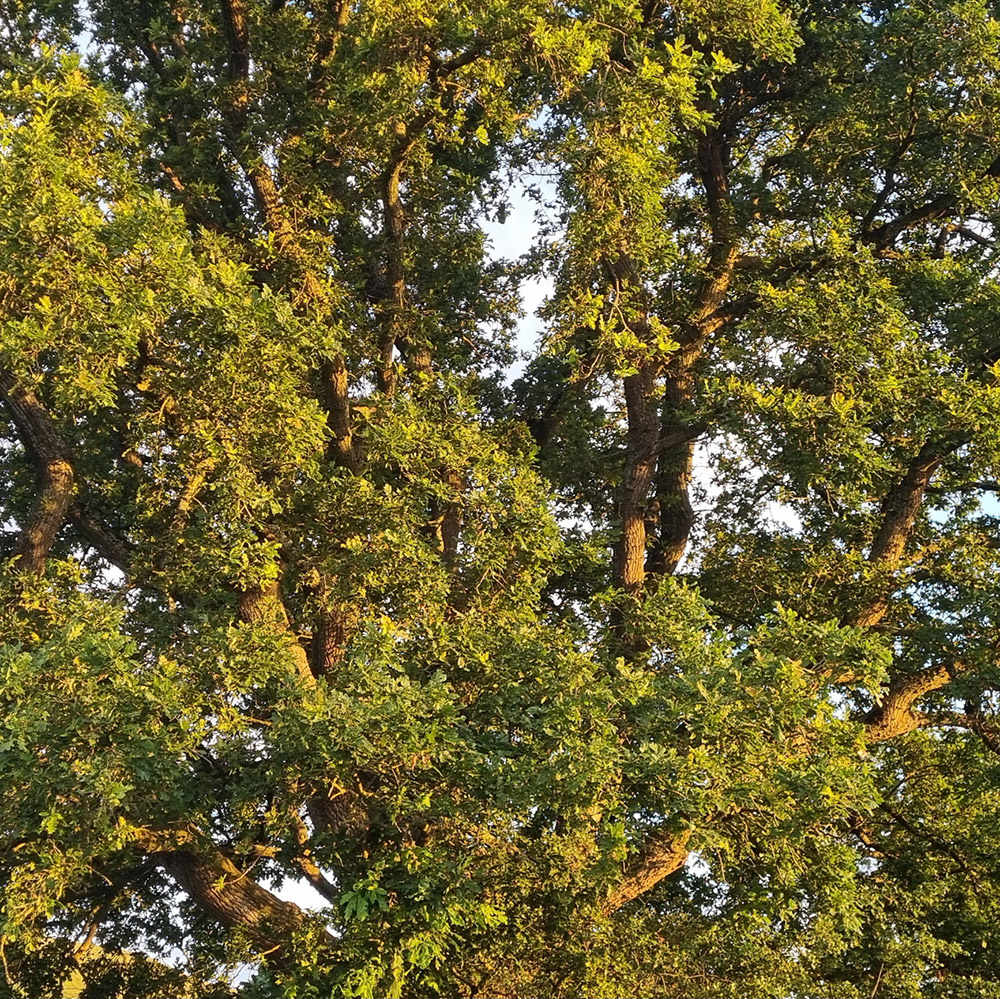
The Singing Oak Sunset
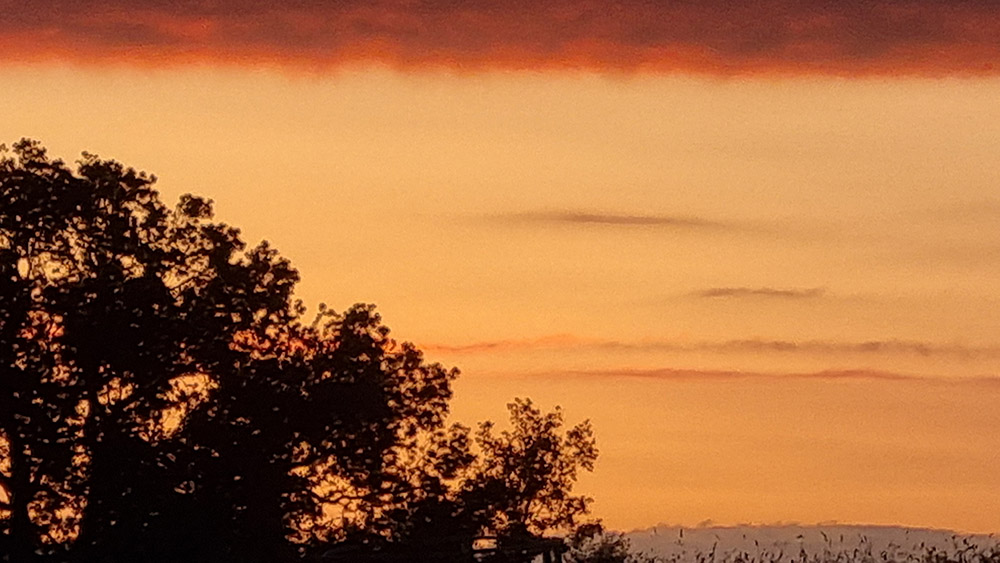
Oak Sunset
The tree has an ominous placement: a line drawn east from St John’s Church, leads directly into its path. It’s in direct view of both the Tor and Challice hill nestled within an old boundary at the edge of a shallow earthen bank, in a field surrounding the highest point up on the down. From here, there are views towards every horizon, except where the Tor creates its own much closer sky edge. The field is private and often contains grazing cattle, so please seek permission from the landowner before entering.
During the Summer, the tree’s huge canopy provides a wide circular pool of cool shade, for those inclined to seek shade in such beautiful weather. Personally, I prefer to head out in the early evening and sit in the open field until the shadow of the hedgerow extends far enough to touch my feet.

From here, my sunsets are often enjoyed twice over. The first arrives as the sun drops into the hedge, appearing for a time as countless tiny suns glistening through the dense thickets. Once I have left the field, a second sunset falls over the distant horizon beyond Brent Knoll, as the earth on which I stand revolves away from the sun and descends into darkness.
In autumn and winter, when the weather becomes less appealing, the tree becomes a beacon of shelter on an otherwise exposed hilltop. Its trunk and the surrounding thorns provide a windbreak, while its substantial protruding limbs offer some shelter from the rain. Winter brings a different kind of intimacy with the trees. In Summer, we bathe in their beauty and shadow and gaze towards their leafy clouds. In Winter, we are drawn closer, the guitar is left at home, and we are left with the rawness of the season and the bareness of words alone.
MW – 29/7/2026
The Interactive Oak Map

The map includes the locations of the largest and oldest oaks, or avenues of younger oaks, spread amongst the hills and the town. As these oaks are so spread out I have not suggested a route, instead I have simply marked their positions so that you may, in the course of one or more outings, visit each of Avalon’s venerable oaks.
Also marked on the map are the younger oak rows. Extensive oak planting has taken place over the course of the last few decades on the processionary ways around Wick, Stone down, Paradise lane, and Wearyall as well as on the causeway at the south west side of Glastonbury.
Many oaks are not included, either due to access, because they lay too far into private land, or that they are not yet of a notable size or included within an avenue. I estimate that we have upwards of 300 oaks in total hidden within the bounds of the isle.
Enjoy your oak adventures.
SUMMER TREE WALK DATES
Summer Walks:
Aug: Sun 9th, Sat 15th, Sat 29th
Autumn Walks
Sep: Sat 6th, Sat 13th, Sat 19th, Sun 27th
Oct: Sat 3rd, Sun 11th, Sat 17th, Sun 25th
Nov: Sat 7th, Sun 14th (last of season)
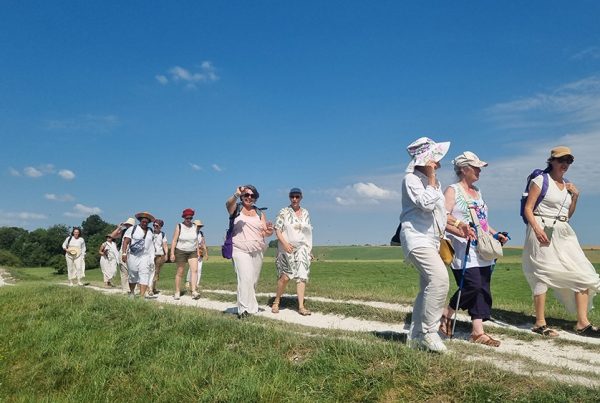
Meet at the gates to St John’s Church on Glastonbury High Street at 11am – £10pp.
RSVP: 07548 936 081
Private walks are available to book at a date and time to suit you – Book.

VISUAL DIARY